
When to Sign Up for 3 Month Electricity Plans
2 minute readThree-month electricity plans can be a smart choice if you time them right. In Texas, electricity prices fluctuate throughout the

Comprehensive Guide to Selecting a Texas Electricity Plan
12 minute read • Last update June 2026

To find the best electricity plan in Texas, you need to evaluate your home’s size and monthly electricity consumption, then identify the plan type, contract length, and contract terms and costs that match your specific needs.
Texas has a deregulated energy marketplace, which means there are dozens of providers and hundreds of plans to pick from, some of which are better than others for your specific location, electricity usage, and home type.
This simple yet comprehensive guide walks you through each step of the electricity plan shopping process so you can compare confidently and find the best energy plan for you.
These are the steps to find the best electricity plan in Texas for your home:
To pull the last 12 month’s of your home’s electricity usage, you have three potential options: check your historical bill documents, view usage history charts in your provider’s account portal, or create an account on Smart Meter Texas.
Your home’s usage history is the most important factor in your energy shopping experience because varying plan structures can lead to wildly different bill amounts.
For example, the same exact plan with tiered rates or a bill credit could be affordable for someone with a home that consumes 2000 kWh and very expensive for someone else in a home that uses 500 kWh.
Moving into a new place? Ask the property manager or current owner if they’re willing to share their electricity consumption history.
After finding your home’s electricity consumption history, it’s time to start shopping for plans. The best places to find Texas electricity plans are directly on provider websites (like bkvenergy.com) or on the state-operated website PowerToChoose.org.
Provider websites are a great place to shop for energy plans because they often offer exclusive rates, plan types, promotions, or benefits that you cannot find anywhere else.
PowerToChoose.org is a great place to shop because the site is run by the Public Utility Commission of Texas, which means that it is unbiased, neutral, and comprehensive. The website does have some drawbacks such as a clunky interface and filters that allow for some tricky pricing structures to land at the top of the list.
Check out our PowerToChoose shopping tips to become an expert.
The Electricity Facts Label (EFL) document is your number one tool for evaluating and comparing electricity plans because they are a standardized document that every plan must have.
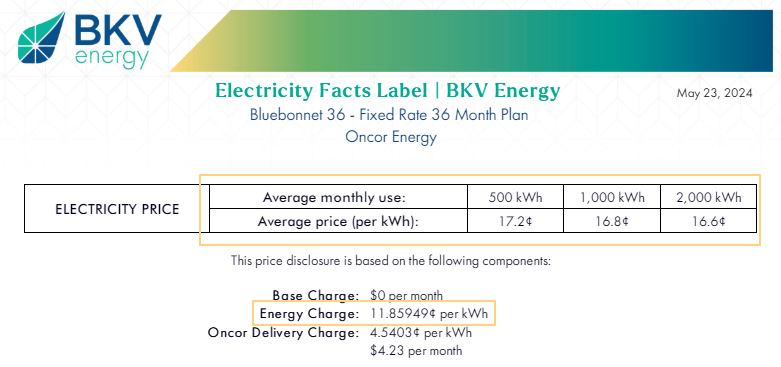
The EFL contains the details of an electricity plan, including average price at 500, 1000, and 2000 kWh, energy charge, delivery charges, term length, and other fees and terms.
How to Read an Electricity Facts Label
You can use your kWh usage history and the information from EFL documents to calculate estimated bills and determine which plan is best for you.
Here’s the formula to calculate a bill estimate:
Bill = kWh Usage x (Energy Charge + TDU Delivery Charge per kWh) + Monthly TDU Charge
Let’s walk through a few examples:
| Bill Element | Plan A | Plan B | Plan C |
|---|---|---|---|
| Plan Type | Simple fixed-rate | Fixed-rate with base charge | Fixed-rate with bill credit |
| kWh Usage | 2000 kWh | 2000 kWh | 2000 kWh |
| Energy Charge | $0.075 per kWh | $0.075 per kWh | $0.15 per kWh |
| TDU Delivery Charge | $0.051683 per kWh | $0.051683 per kWh | $0.051683 per kWh |
| Monthly TDU Charge | $4.23 per month | $4.23 per month | $4.23 per month |
| Base Charge | $0.00 per month | $9.95 per month | $0.00 per month |
| Bill Credit | None | None | $125 at 1000 kWh |
| Estimated Bill | $257.60 | $267.55 | $282.60 |
Electricity Facts Labels also list the contract or term length, how many months the plan lasts.
Texas electricity providers offer a wide range of contract lengths, ranging from 1 month to 3 years. Sometimes you may even find a 4 or 5-year plan.
How do you know which one is right for you? Well, each term length has its pros and cons, and some are more appropriate for one shopper over another. Let’s dive into the details of commonly offered plan terms.
| Term Length | Benefits and Considerations |
|---|---|
| 1 month | Variable plans offer short-term flexibility and are appropriate for folks who are planning to move in the near future. |
| 3 months | Similar to a 1-month plan, 3-month plans offer short-term flexibility for those anticipating a move. They are also useful for resetting your renewal cycle to the spring or fall when rates tend to be lower. |
| 6-9 months | A 6-9 month plans offers the same flexibility as shorter terms, with the added benefit of aligning your renewal period with the lower-rate seasons. This can help break a cycle of summer or winter renewals when rates are typically higher. |
| 12 months | Perfect for renters on annual leases or homeowners seeking a mid-term contract, 12-month plans offer stability without a long-term commitment. |
| 24-36 months | These longer-term plans generally come with lower rates compared to 12-month options, making them ideal for homeowners or long-term renters who prefer to avoid the hassle of yearly renewals. |
| 48 months or longer | Though less common, plans of 4 years or more can be advantageous for homeowners looking to lock in a long-term fixed rate and avoid frequent contract renewals. |
There’s no catch-all right answer for which term length is best because everyone’s circumstances are different. Weigh the pros and cons of each offering and select the option that best fits your needs and lifestyle.
When comparing plans, don’t compare average prices. Instead, look for a low energy charge.
Most electricity provider and plan comparison websites show the average price of a plan based on a standard usage of 2000 kWh per month.
This can be misleading, especially if your energy consumption varies from month to month or if your household uses significantly more or less energy than average. As a result, you may not be seeing the true cost of electricity for your specific usage needs.
How can you know what you’ll actually be paying? This brings us back to BKV Energy’s timeless mantra—always, always, always check the Electricity Facts Label.
When you look at the Electricity Facts Label, you’ll find a table showing the average price of electricity at usage levels of 500, 1000, and 2000 kWh. This breakdown helps you compare how energy prices vary based on consumption. Below that, you’ll notice a line labeled “Energy Charge” — this is the key figure to focus on when comparing plans.
Early cancellation fees or early termination fees are applied when you leave a contract before its completion date.
There are generally two types of early cancellation fees:
Our recommendation? Choose a plan that has an early termination fee that decreases the longer you’re a customer.
That way, if you decide to leave for any reason, it’s easier to switch providers or plans.
30 days before your current plan ends, your provider is required to send an expiration notice. This is your sign to begin shopping for a new plan if you don’t want to renew with your current provider.
If you switch to a new provider in the final 14 days of your plan, you will not be charged an early termination fee. This is the best window to make the switch.
There are two main types of plans: fixed-rate and variable-rate.
When shopping for electricity, we almost always recommend looking for a fixed-rate plan.
Fixed-rate plans are the best option for most Texans because you’re locked into the same energy for the entire contract, even if market rates increase. That means you’re protected from the increased costs of electricity during summer months when demand on the grid is much higher.
On a variable-rate plan, the energy charge is typically very expensive and subject to change on a monthly basis. They are unpredictable, lead to high bills, and can become incredibly costly during the summer.
Variable-rate plans are a good option for people who only need power temporarily, so getting stuck with a long-term plan does not make sense.
| Rate Type | Explanation |
|---|---|
| Fixed | The price per kilowatt-hour remains constant for the duration of your contract. They are not impacted by fluctuations in market prices. |
| Variable | The price per kilowatt-hour can change every month during your contract. When market prices increase, the rate increases and vice versa. These rates are set at the discretion of the provider. |
There are a few sub-categories of fixed-rate plans to know as well: bill credit plans and time-of-use plans.
Bill credit and time-of-use plans can seem like a great idea. Who doesn’t like bill credits or free energy, right?
Unfortunately, bill credit and time-of-use plans come with very expensive energy charges and ultimately lead to higher bills for most Texans.
The energy charge is generally so high that it’s difficult to save money in the long-term, even with the bill credits and free power.
When reviewing a plan’s EFL, watch out for fees and gimmicks like base charges, minimum usage fees, time-of-use terms, and bill credits.
Many providers include these fees and marketing gimmicks, which can increase your annual spending on electricity by hundreds of dollars.
Typically, the best time of year to shop for electricity in Texas is during the spring (March through May) or fall (October through November).
These months generally offer lower rates because demand on the Texas grid drops.
Summer (June through September) is usually the most expensive time to lock in a rate.
Beyond seasonal timing, pay attention to your contract expiration date. Providers are required to send you a renewal notice 30 days before your plan ends. That notice is your signal to start shopping.
If you wait too long to switch and let your contract expire, most providers will automatically roll you into a month-to-month variable rate that can be 30 to 50% higher than what you were paying.
Estimating the cost of your monthly bills is arguably the most important step when selecting the best electricity plan for your home because it shows you what you can expect to pay on a specific plan.
Take your 12 months of usage history data and apply it to the cost structure of a plan you’re considering.
Compare the estimated bills to your real payment history to determine if the new plan fits your budget.
You can use the BKV Energy electricity bill calculator or download our bill calculator Excel spreadsheet.
Provider websites and PowerToChoose.org are not the only places to find electricity plans. There are many other comparison websites and services like Energy Bot and Energy Ogre.
Those tools list plans that you will not find on PowerToChoose.org. If you don’t want to spend time digging through plans or estimating bill amounts, sites like these can do a good job of handling that work for you.
There are a few more factors to pay attention to when comparing electricity providers in Texas:
For most Texans, a simple fixed-rate plan with a low energy charge is the best option. Fixed-rate plans lock in your energy charge for the duration of the contract, which protects you from summer price spikes when grid demand is the highest. We recommend avoiding plans with variable rates, as well as fixed-rate plans with base charges, minimum usage fees, bill credits, or time-of-use terms.
We recommend fixed-rate plans for the vast majority of households. Variable-rate plans offer month-to-month flexibility with no long-term commitment, but the rate is set based on wholesale market conditions, and they are typically much more expensive than fixed-rate plans. Variable-rate plans may make sense in scenarios where you need electricity temporarily for a short-term lease or if you’re about to move.
You can find your monthly kWh usage on your past electricity bills, listed as “usage” or “kWh used.” For more detailed views, you can create a free account with Smart Meter Texas (https://smartmetertexas.com), which provides daily and monthly usage data. Knowing your monthly usage data helps you more accurately compare plans and determine which one is best for your household.
A good energy charge for a fixed-rate plan in Texas will fall between 5-9 cents per kWh, depending on the time of year, plan length, and overall market conditions. Keep in mind that the energy charge is only one component of your bill. TDU delivery charges, base charges, and other fees will impact your total cost and all-in average price. Always compare plans by looking at the energy charge on the Electricity Facts Label rather than the advertised average price.
The advertised average price you see on plan listings is calculated at three specific usage levels: 500, 1000, and 2000 kWh. If your usage doesn’t exactly match one of those levels, your average price per kWh will differ. Plans with base charges, minimum usage fees, time-of-use terms, and bill credits are especially prone to this because the fixed fees and credits shift the average price significantly at different kWh consumption levels.
Some providers may require a deposit for new customers, typically ranging from $100 to $400, depending on the plan length, your credit history, or your expected kWh usage. Many Texans qualify for deposit waivers with proof of 12 months of on-time bill payments, if they are 65 years or older, or if they are a victim of family violence. Some providers also offer no-deposit or prepaid plans, although these often come with higher prices.
Yes, if you pay your own electricity bill, you have the same ability to shop and choose a plan as a homeowner. Your lease or apartment management should not restrict or require you to select a specific provider, although they may recommend one.
At BKV Energy, we work hard to offer electricity plans that meet all of the above criteria to help Texans save big on their monthly energy bills. If you’re interested in switching to a provider with affordable fixed rates, no unnecessary fees, great customer service, a robust rewards program, and much, much more, then enter your zip code below.