If you’re shopping for electricity in Texas, learning how to read an EFL is the single most important thing you can do to avoid surprises on your bill.
In this guide, we’ll walk you through every section of the Electricity Facts Label so you can confidently compare plans and choose the one that’s right for your home.
What is an Electricity Facts Label (EFL)?
In Texas, an Electricity Facts Label (EFL) is a standardized document provided by electricity providers to inform consumers about the details of their electricity plans. They are meant to help shoppers compare plans between providers.
The Public Utility Commission of Texas (PUCT) mandates these documents and standardizes their layout. This standardization gives consumers a better idea of how these plan details impact their bills. While EFLs from different companies may vary slightly, their overall structure looks similar.
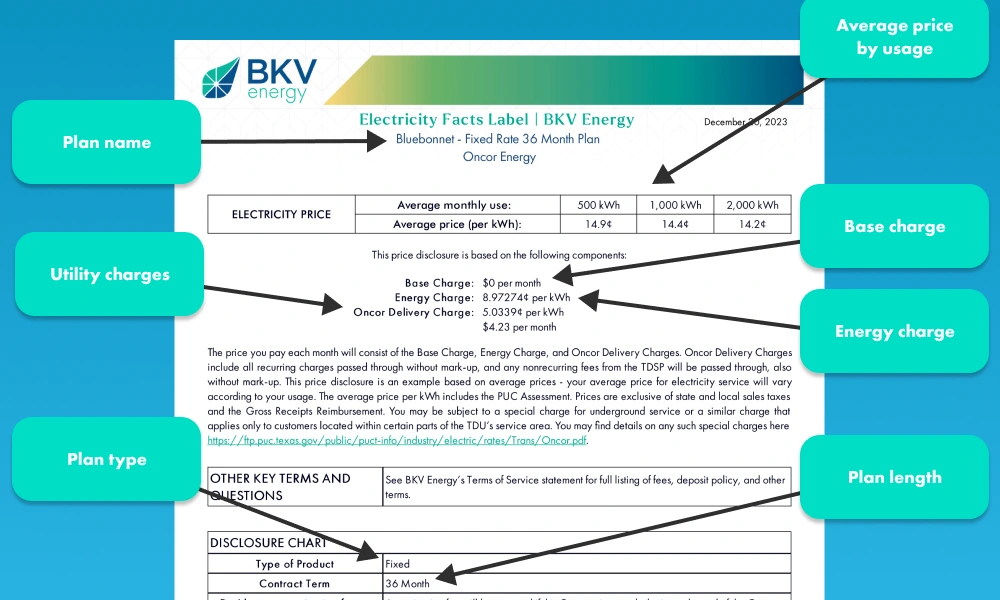
EFLs list key plan details, such as: average price at 500, 1000, and 2000 kWh, energy charge, delivery charges, and any other additional fees.
How to read an Electricity Facts Label
The EFL aims to empower consumers with transparent and comparable information, enabling them to make well-informed decisions when choosing an electricity plan in the deregulated energy market of Texas.
How to read the Electricity Price (Price Disclosure) section
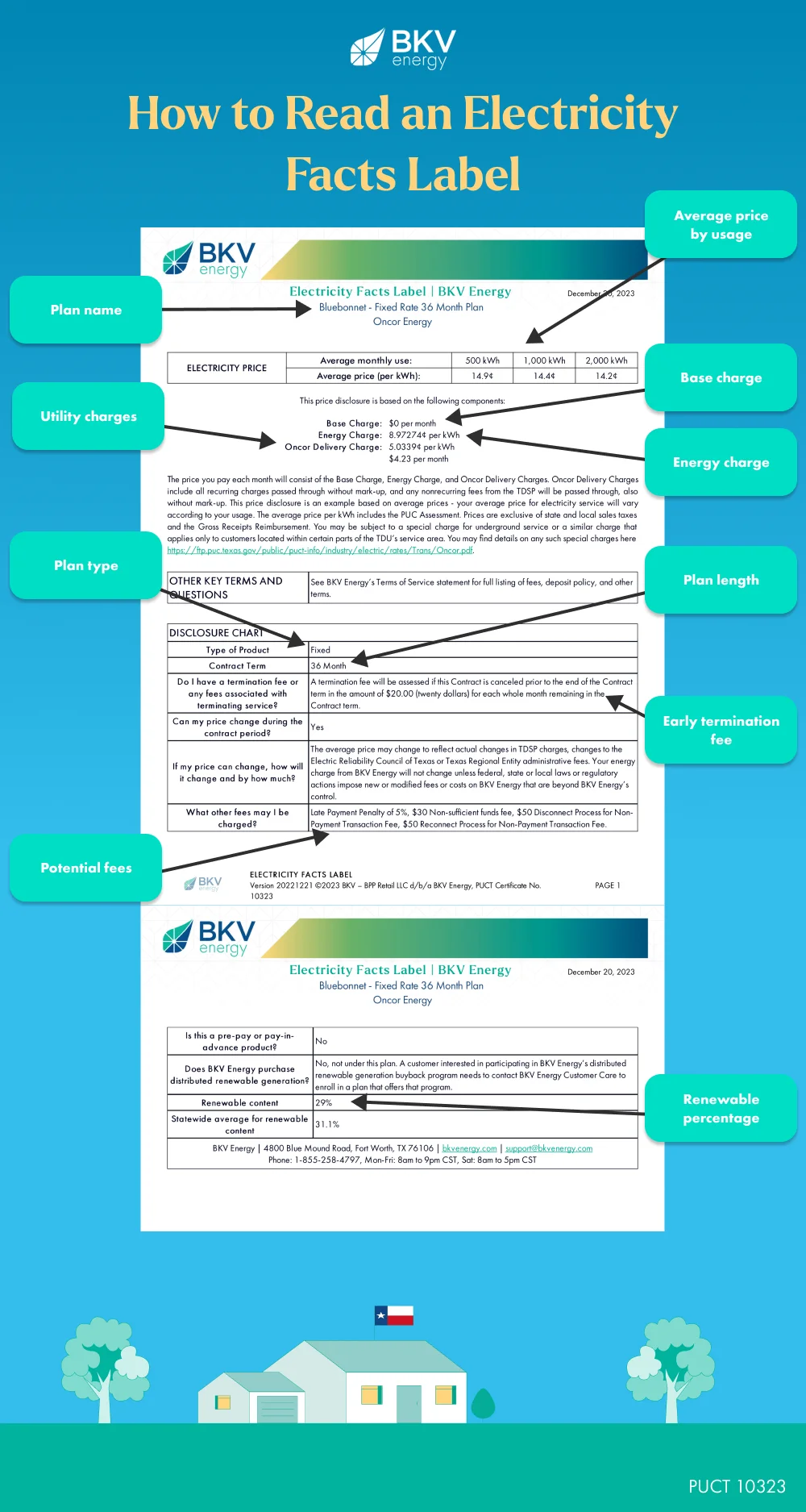
The Electricity Price section is the top half of the EFL and covers pertinent information, including the average price per kWh at 500, 1000, and 2000 kWh usage, base charges, energy charge, and TDU delivery charges.
Average Price – average price per kWh based on 500, 1000, and 2000 kWh usage levels (why are there three prices?)
Energy Charge – price per kWh for electricity, which will be fixed or variable
Base Charge – some companies include monthly base charges regardless of energy use (BKV Energy does not)
Minimum Usage Fee – some providers charge you when you use too much or too little electricity (BKV Energy does not)
How to read the Disclosure Chart section of an EFL
The Disclosure Chart section of the EFL is the bottom portion that covers the following information: product type, contract term (length), early termination fees, renewable energy content, and more.
Plan Type – indicates whether the plan is fixed or variable rate
Contract Term – number of months in your contract
Early Termination Fee – fee for canceling your contract early (BKV Energy’s ETF is $20 per remaining month)
Can Price Change? – clarifies whether your price can change during the contract
Why Prices Can Change and By How Much? – explains that average prices may change due to fluctuations in TDU delivery charges as approved by the PUCT, and that the energy charge from your provider will not change (if the plan is fixed)
Other Fees – potential fees for late payments, insufficient funds fees for debit cards and bank accounts, disconnect fees, reconnect fees
Pre-Pay or Pay-in-Advance – specifies whether the plan is prepaid or postpaid
Purchase Distributed Renewable Generation? – explains whether the plan offers solar buyback
Percentage of Renewable Content – amount of electricity from renewable sources (choose between 29% and 100% renewable with BKV Energy)
Statewide Average for Renewable Content – shows the current statewide plan average for renewable energy content
Fees, charges, and terms to watch out for on Electricity Facts Labels
Some plans will include fees, charges, or terms that can significantly increase the cost of your electricity bill, such as base charges, minimum usage fees, time-of-use terms, and bill credits.
Base charges – Base charges range from $4.95 to $14.95 per month, depending on the provider and/or plan. They are added to every bill and are not tied to your energy consumption. This means you could end up paying around $60 to $180 extra to your provider over 12 months.
Minimum usage fees – Minimum usage fees are typical $9.95 and are added to your bill when you use less than 800 kWh during a billing period. This fee, in particular, punishes Texans who live in smaller homes or are good at conserving energy.
Time-of-use – Time-of-use terms are typically advertised as free nights or free weekends. Plans with “free” time windows will have energy charges that are twice as expensive as a regular plan. It is incredibly difficult to shift enough energy consumption to the “free” windows and save money with these plans.
Bill credits – Bill credits make electricity plans look very, very affordable when you hit an exact kWh usage–even though they have super high energy charges. When you don’t hit that exact usage, you either do not receive the credit or the credit “wears off,” and you end up overpaying.
At BKV Energy, we recommend avoiding plans with base charges, minimum usage fees, time-of-use terms, and bill credits. The majority of Texans will spend much, much less with a simple fixed rate plan with pricing terms that exclusively feature an energy charge and TDU delivery charges.
How to calculate a bill from an EFL
When you examine an Electricity Facts Label, electricity costs can be estimated using this formula:
Energy Bill = kWh Usage x (Energy Rate + TDU Delivery Rate) + TDU Monthly Fee
You can find the Electricity Facts Label for a plan in several places:
On the provider’s website, look for a link labeled “Electricity Facts Label” or “EFL” on a plan listing. If you can’t easily find the EFL, consider that a red flag, as the provider may be hiding information on purpose.
During the signup, provider or broker websites should display or link to the EFL before you finalize the enrollment. Always open and review the document before you agree to the plan.
On PowerToChoose.org, the PUCT’s official plan comparison and shopping site, each plan listing includes a link labeled “Fact Sheet.”
After you enroll, you will receive the EFL via paper mail or to your email inbox, depending on your chosen communication preferences. If the document doesn’t seem to match what you signed up for, contact your provider immediately.
Why you should read the EFL
Whether you’re shopping for a new plan with a new provider or reviewing renewal offers from your current provider, reading the Electricity Facts Label before enrolling is crucial to understanding your expected electricity costs.
Before making a decision, pay attention to the energy charge, potential base charges or usage fees, cancellation fees, and other details that may impact your bill. Compare multiple plans to ensure you’re getting the best deal for your needs.
When it comes to EFLs, our number one recommendation is to always, always, always read the Electricity Facts Label before making a decision.
Frequently asked questions about EFLs
What is an Electricity Facts Label (EFL)?
An EFL is a standardized fact sheet that covers electricity plan details such as rates, fees, contract terms, and renewable energy percentages. They are designed to make the process of comparing electricity plans easier.
What is the difference between energy charge and average price?
The energy charge is the per kWh rate you pay your electricity provider.
The average price is the cost per kWh you pay for electricity at a specific kWh usage that includes energy charge, delivery charges, and other fees.
What is the difference between fixed rates and variable rates?
Fixed-rate plans refer to plans with energy charges that are locked in, or do not change, during a contract.
On a variable-rate plan, the energy charge is subject to change each month based on wholesale market conditions. Typically, they become very expensive during the summer and winter.
Should I shop using the 500, 1000, or 2000 kWh average price?
Rather than shopping based on average price, BKV Energy recommends shopping by energy charge. You are better off finding a great deal by looking for a fixed-rate plan with a low energy charge, while avoiding fees and gimmicks such as base charges, minimum usage fees, time-of-use, and bill credits.
If you’d like to by average price based on your real usage, you can check your kWh consumption history with your electricity provider or create an account with Smart Meter Texas.
Why are there three electricity prices on an EFL?
The three prices (at 500, 1000, and 2000 kWh) exist because most electricity plans include fixed monthly fees, like the TDU monthly charge or a base charge, that get spread across however many kilowatt-hours you use. The more electricity you use, the more those fixed costs get diluted, which lowers your average price per kWh. The less you use, the more those fixed fees weigh on your average.
The three usage levels exist to show how your average price changes depending on your consumption. A plan might look cheap at 1000 kWh but be noticeably more expensive at 500 kWh because that same monthly fee is divided across fewer kilowatt-hours, or a bill credit could significantly impact the average price.
This is why we recommend shopping by energy instead of average price; it strips out that math and lets you compare the actual rate you’re paying for electricity itself.
Choose a Bluebonnet plan to enjoy electricity with the following benefits:
$0 monthly base charge
$0 usage fee
$0 early termination fee in the first 30 days
No marketing gimmicks
Super affordable fixed energy charge
Decrease your per kWh price mid-contract for free with Reduce Your Rate
Annual customer loyalty payout with ElectroShare
Severe weather and energy-saving tip notifications with Spark Alerts
No interest deferred payment plan with Save Now, Pay Later
Personalized plan renewal services with Contract Consultation
Texans can save up to $800 per year by choosing BKV Energy. Enter your zip code to explore simple, fixed-rate energy plans for homeowners and renters in Texas.
Graham Lumley is the Growth Product Manager at BKV Energy, a retail electricity provider in Texas' deregulated market, where he has worked since 2023. He analyzes customer usage and billing data, helps develop BKV's fixed-rate plans, and creates tools to simplify Texas electricity shopping. He has written over 200 articles on Texas electricity rates, delivery charges, plan types, energy generation, and more to help Texans understand their bills and pay less. With over 10 years of experience in consumer products, marketing, and energy, he explains the Texas electricity market in plain language.
Enter your zip to shop BKV Energy's fixed-rate electricity plans.
Manage Consent
We use cookies to enhance your site experience, improve functionality, and analyze visitor usage. By clicking "Accept All," you consent to our use of all cookies. If you prefer to decline statistics and marketing cookies, you can opt out at any time by clicking "Cookie Info & Settings" below and navigating to "Manage your opt-out preferences."
Functional Always active
The technical storage or access is strictly necessary for the legitimate purpose of enabling the use of a specific service explicitly requested by the subscriber or user, or for the sole purpose of carrying out the transmission of a communication over an electronic communications network.
Preferences
The technical storage or access is necessary for the legitimate purpose of storing preferences that are not requested by the subscriber or user.
Statistics
The technical storage or access that is used exclusively for statistical purposes.The technical storage or access that is used exclusively for anonymous statistical purposes. Without a subpoena, voluntary compliance on the part of your Internet Service Provider, or additional records from a third party, information stored or retrieved for this purpose alone cannot usually be used to identify you.
Marketing
The technical storage or access is required to create user profiles to send advertising, or to track the user on a website or across several websites for similar marketing purposes.