Texas is the largest deregulated energy marketplace in the United States.
Energy deregulation means you get to pick your electricity provider.
The market is split into three main parts: generation, transmission/distribution, and retail electricity providers.
Not all of Texas is deregulated: Austin, San Antonio, and El Paso do not have the power to choose.
Signing up is simple. Compare plans online, then submit an application. Your provider handles the rest.
Understanding energy deregulation is key for anyone using electricity in Texas. It doesn’t matter if you own a home, rent, or run a business – knowing how energy deregulation works can help you make smart choices about your energy provider and plan.
This guide will go over the basics of energy deregulation, look at its advantages and disadvantages, and answer common questions. The goal? To help you navigate the Texas energy market with confidence.
What is Texas energy deregulation?
Texas energy deregulation refers to a system where retail electricity providers (REPs) compete to sell electricity to consumers, and where consumers have the power to choose their own supplier from this marketplace.
This energy marketplace is distinct from regulated energy markets, where consumers have no choice in who supplies their electricity.
In Texas, over 85% of the state is deregulated, so most residents and businesses can choose who supplies their electricity.
While a majority of Texans can choose who provides power to their home, they do not have a choice in the utility company (Transmission and Distribution Utility, or TDU) that manages the poles, wires, and transformers that actually deliver the power to their physical residence.
How does Texas’ deregulated energy market actually work?
The deregulated energy market in Texas is split into three parts: generation, transmission/distribution, and retail electricity providers.
The system begins with generation at natural gas power plants, nuclear power plants, wind farms, and solar farms around the state.
REPs purchase wholesale electricity from generators on behalf of their customers.
Electricity is transported from the power plants through power lines managed and maintained by Transmission and Distribution Utilities (TDUs) to homes and businesses around Texas.
The Electric Reliability Council of Texas (ERCOT) manages the flow of power across the grid to ensure that there is enough supply to meet demand.
The Public Utility Commission of Texas (PUCT) ensures that REPs are following the law while servicing customers, and works with TDUs to set utility rates.
Electricity providers promote their various electricity plans online for customers to choose from.
How is Texas’ deregulated market different from other states?
There are other states in the U.S. with deregulated energy, but the market in Texas is very unique:
Leading deregulated energy market: With nearly 12 million households and a population exceeding 31 million, Texas holds the distinction of being the largest deregulated energy market in the United States.
Comprehensive deregulation: Unlike many other states, Texas does not have a government-backed utility, allowing for a wider diversity of energy plans and types.
Designated regulating entities: Texas has its own governing agencies, the Electric Reliability Council of Texas (ERCOT) and the Public Utility Commission of Texas (PUCT). ERCOT manages the state’s power grid, while PUCT oversees electricity providers, ensuring compliance with regulations.
Power to Choose: This resource, operated by PUCT, provides Texans an impartial platform to compare energy plans and providers, aiding consumers in making informed decisions regarding their energy options.
Separation of power generation & delivery: In Texas, power generators produce electricity, retailers sell the power to consumers, and utilities deliver it through the grid. This division of roles enables each entity to focus on its core competencies, enhancing efficiency and competitiveness in the market.
Independent power grid: Texas maintains its own power grid, separate from the Eastern and Western Interconnections that supply power to the rest of the United States. This unique arrangement allows the state to independently manage its energy resources.
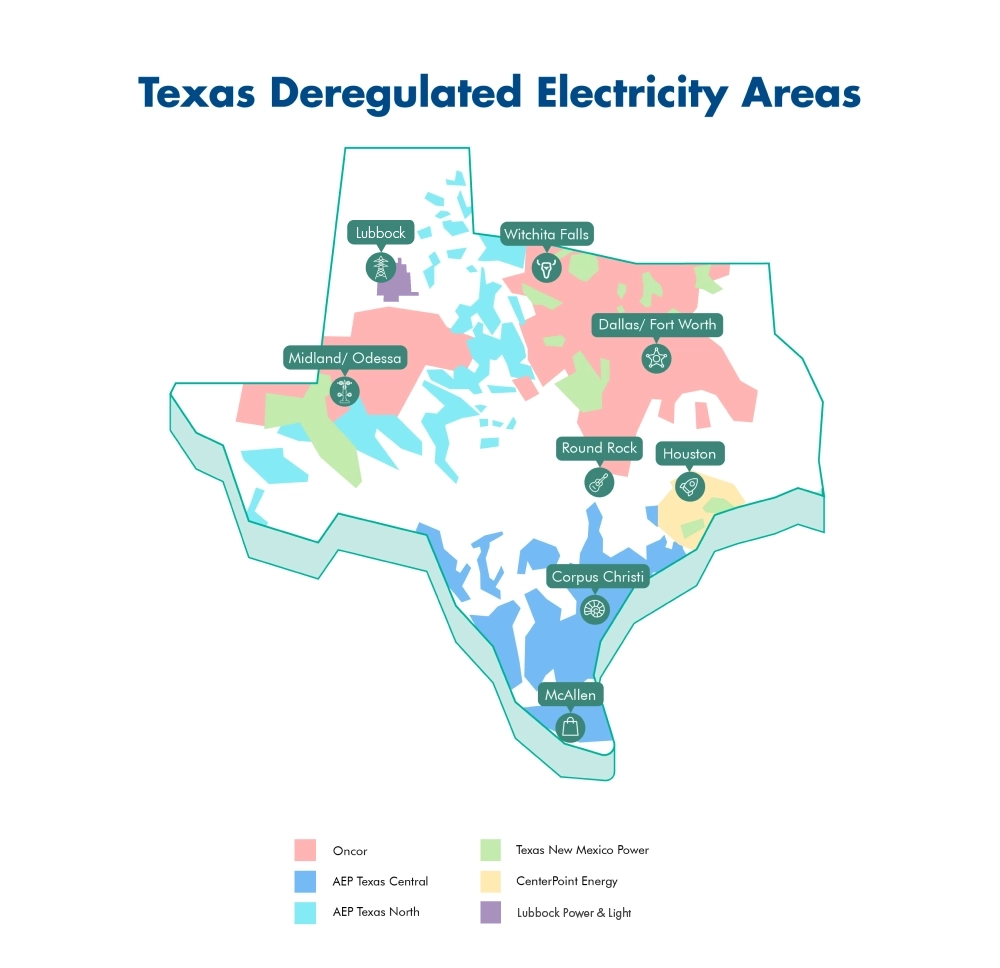
This is a map of the deregulated energy market service areas in Texas, by TDU that owns the territory. In Texas’ deregulated market, ERCOT manages an ecosystem where the production and sale of energy has been separated from the distribution of the energy. The companies that manage the electrical grid’s components and are responsible for repairs during blackouts are called Transmission and Distribution Utilities or Transmission and Distribution Service Providers.
What about areas outside of the ERCOT deregulated energy market?
Texas, with its diverse regional grids, covers about 85% of residences under its umbrella of deregulation. Nevertheless, several cities and regions, including Austin, San Antonio, and El Paso, have not adopted deregulation.
These regions continue with municipally owned utilities or electric cooperatives. In these areas, the energy market structure remains traditional, where a single entity is responsible for both the generation and delivery of power.
How to get electricity service in Texas
Setting up electricity in Texas is less complicated than it may seem:
Compare rates and plans online. Shop online at PowerToChoose.org or directly on a provider website like bkvenergy.com
Select a plan and submit an application. You will need to provide your address and some other personal details in order to receive service.
Your new provider handles the rest. Once your application is accepted, your electricity provider takes care of everything else.
History of energy deregulation in America (and Texas)
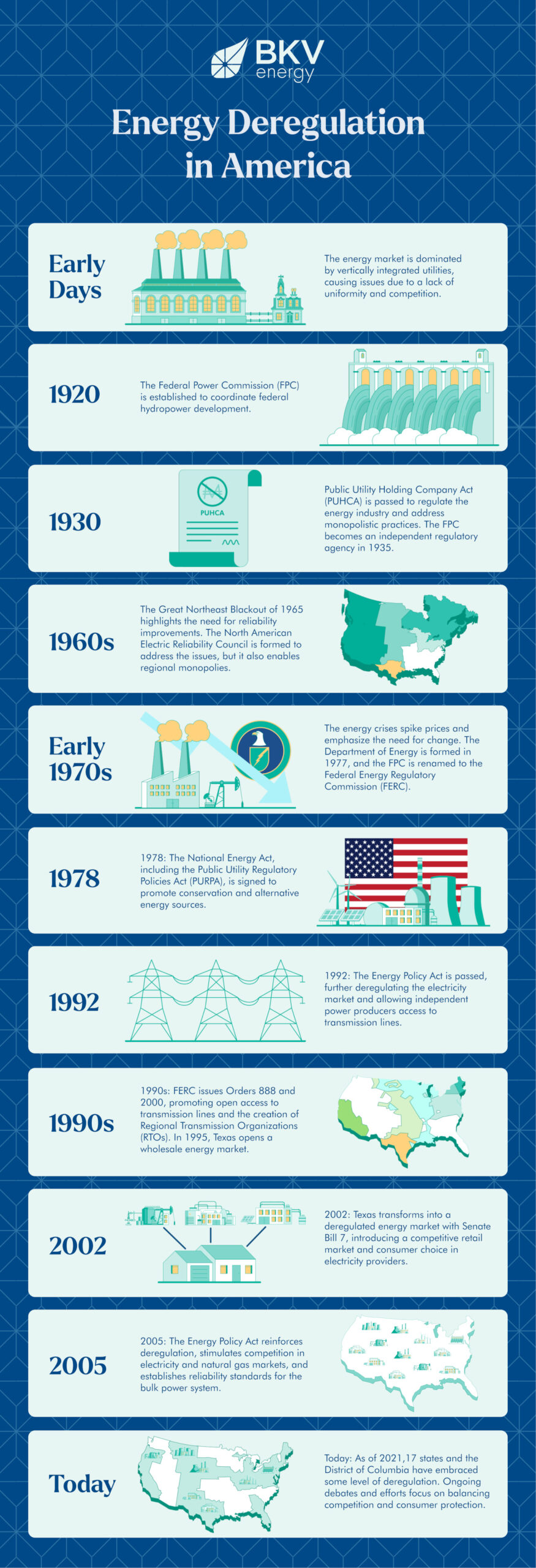
Let’s delve into the evolution of energy deregulation in the U.S., beginning from the initial state of the energy market:
Early Days: The energy market was dominated by vertically integrated utilities. This was a period of rapid advancements, competing standards, and a lack of regulation. A lack of uniformity in energy distribution caused problems for consumers.
1920s: The Federal Power Commission (FPC) is established by Congress to coordinate federal hydropower development.
1930s: The US government passed the Public Utility Holding Company Act (PUHCA), introducing regulation to the growing energy industry. In 1935, the FPC becomes an independent regulatory agency.
1960s: The Great Northeast Blackout of 1965 leaves over 30 million people in the US and parts of Canada without electricity. The electric utilities industry created the North American Electric Reliability Council to address the issues and improve energy distribution reliability. However, it also allowed regional monopolies to form, and the lack of competition sometimes resulted in higher energy costs and no reason to better serve customers.
Early 1970s: The energy crises of the 1970s spiked prices higher, led largely by oil costs from OPEC. To ween America off this expensive energy source, utilities began developing power plants for other energy sources, and Americans are stuck with the costs.
1977: In response to the oil crisis, Congress formed the Department of Energy to consolidate energy-related agencies into a unified agency. The FPC is renamed to the Federal Energy Regulatory Commission (FERC) and retains its independence within the DOE.
1978: President Jimmy Carter signed the National Energy Act, which includes the Public Utility Regulatory Policies Act (PURPA). This legislation aimed to promote energy conservation and reduce our reliance on foreign oil.
1992: The Energy Policy Act is passed, taking deregulation a step further. This act broke down legal barriers in the electricity market and enabled independent power producers to access transmission lines, setting the stage for retail competition.
1990s: The Federal Energy Regulatory Commission (FERC) issued Orders 888 and 2000, promoting open access to transmission lines and encouraging the creation of Regional Transmission Organizations (RTOs). In 1995, Texas opened a wholesale energy market, allowing independent power producers to sell electricity directly to utility companies.
2002: Texas transformed into a deregulated energy market, following the passage of Senate Bill 7. This legislation granted consumers the power to choose their electricity provider.
2005: The Energy Policy Act is signed, reinforcing the trend of deregulation. This act further stimulated competition in the electricity and natural gas markets and establishes essential reliability standards for the bulk power system.
Today: The deregulation movement continues to expand, with 18 states and the District of Columbia embracing deregulation as of 2026.
How has energy distribution and regulation changed in the United States over the past 100 years? Check out our timeline above for more details on how getting energy from the plant to your home has evolved.
Which states have deregulated energy markets?
As of 2026, 13 states and the District of Columbia have fully deregulated energy markets. These states include Texas, Ohio, Pennsylvania, Massachusetts, Connecticut, Delaware, Illinois, Maine, Maryland, New Hampshire, New Jersey, New York, and Rhode Island.
Five states have partially deregulated their energy markets, including Michigan, California, Virginia, Oregon, and Nevada.
Let’s highlight key moments in the journey of energy deregulation across the U.S. with a brief timeline:
State-by-state deregulation timeline
1996: California pioneers the movement, turning its electricity market into a competitive landscape.
1997: Rhode Island and Massachusetts initiate the deregulation process, offering their consumers an array of electricity providers to choose from.
1999: Pennsylvania and New York join the trend, sparking competition and opening a variety of choices for consumers in their electricity markets.
2000: New Jersey and Maryland step in.
2001: Connecticut and Delaware join the deregulation bandwagon.
2002: Texas paves the way for an entirely deregulated energy market, showcasing a plethora of electricity providers and novel plan types.
2002-2003: Illinois, New Hampshire, Maine, and the District of Columbia deregulate their markets.
2004-2005: Michigan, Ohio, and Oregon extend the list of deregulated states, widening the scope for their residents to pick their preferred electricity providers.
2006: Virginia embarks on their deregulation journey.
Pros and cons of energy deregulation
Energy deregulation, like any system, brings a blend of advantages and challenges. It has given rise to an array of innovative plan types in Texas, driving competition and consumer choice. However, it has also led to situations like the 2021 grid collapse and Griddy’s bankruptcy in the wake of winter storms. These events underline the complex dynamics that come with navigating the energy market.
PROS
Enhanced competition: This leads to lower prices and a wider selection of plans for customers.
Promotion of innovation: Companies are incentivized to create new technologies and services.
Customer choice: Consumers have the freedom to select the energy plan and provider that best fits their needs.
CONS
Price instability: In a deregulated market, prices can vary significantly.
Potential for misleading marketing: Some companies might resort to deceptive strategies to gain customers.
Possible reduction in consumer protections: Deregulation can occasionally result in fewer safeguards for consumers.
Are you moving to Texas?
If you’re moving into Texas for the first time, energy deregulation may be a brand new, foreign concept.
The best way to get acquainted with energy deregulation? Read articles like this one online. Look for relevant threads and tips on Reddit. Ask your neighbors. You can even give the BKV Energy customer support team a call at 855-258-4797, we’re happy to answer any questions you might have.
Reasons to choose BKV Energy to power your home
There you have it – your comprehensive guide to understanding energy deregulation in Texas. We trust this information will equip you to make knowledgeable decisions about your energy provider and plan.
We hope you consider BKV Energy as your new electricity provider. We prioritize simple, transparent, and affordable fixed-rate electricity plans with no gimmicks and no hidden fees. Plus, we offer cost-saving benefits and rewards with our flagship plan, Bluebonnet.
Frequently asked questions about Texas energy deregulation
What is energy deregulation?
In simple terms, energy deregulation is when the government steps back and allows the market to drive competition among providers. The goal? Lower prices, more plan options, and better customer service for consumers.
How does energy deregulation work in practice?
Energy deregulation works by separating the generation, transmission, and retail sale of electricity. This enables you to choose your energy supplier from various competing companies so that you can find a plan that suits your needs and budget.
Are there any benefits to energy deregulation?
Definitely! Energy deregulation makes competition stronger. This can mean lower prices, more plan choices, and better service for you. Plus, it can lead to more innovation and investment in the energy industry.
What are the risks in a deregulated energy market?
As with any market, there are some risks. In a deregulated energy market, you might face price volatility, misleading marketing practices, and less protection for consumers. In some cases, deregulation can even cause infrastructure issues, as with Texas’ 2021 Winter Storm crisis.
When did Texas become a deregulated energy market?
Texas became a deregulated energy market in stages, starting with the passage of Senate Bill 373 in 1995, followed by Senate Bill 7 in 1999 and the granting of independence to the Electric Reliability Council of Texas (ERCOT) in 2002. These legislative milestones allowed for the separation of electricity generation and distribution, fostering competition and giving customers the freedom to choose their energy suppliers.
What is the Power to Choose?
The “power to choose” is Texans’ right to choose their own energy providers in the deregulated ERCOT market. More specifically, Power to Choose is an online resource provided by the Public Utility Commission of Texas (PUCT). It allows customers to compare energy plans and providers in their area to help them make the best choice.
Which president initiated energy deregulation?
Energy deregulation in the United States began under President Jimmy Carter, who set things in motion with the National Energy Act in 1978.
Which states have deregulated energy markets?
As of 2021, about 17 states and the District of Columbia have embraced some form of deregulated energy markets. This includes the states of California, Rhode Island, Massachusetts, Pennsylvania, New York, New Jersey, Maryland, Connecticut, Delaware, Texas, Illinois, New Hampshire, Maine, Michigan, Ohio, Oregon, Virginia, and the District of Columbia.
How is Texas’ electricity market different from other deregulated states?
Texas has a more comprehensive deregulation process, with no government-backed utility, a separation of the operations between the energy producers, retail providers, and the grid operators. Because of this, Texas’ market has far more retail providers to choose from, and a wider range of plans. Additionally, Texas has its very own energy-governing agencies (ERCOT and PUCT), and a unique electricity market since it’s disconnected from other intercontinental grids.
Graham Lumley is the Growth Product Manager at BKV Energy, a retail electricity provider in Texas' deregulated market, where he has worked since 2023. He analyzes customer usage and billing data, helps develop BKV's fixed-rate plans, and creates tools to simplify Texas electricity shopping. He has written over 200 articles on Texas electricity rates, delivery charges, plan types, energy generation, and more to help Texans understand their bills and pay less. With over 10 years of experience in consumer products, marketing, and energy, he explains the Texas electricity market in plain language.
Enter your zip to shop BKV Energy's fixed-rate electricity plans.
Manage Consent
We use cookies to enhance your site experience, improve functionality, and analyze visitor usage. By clicking "Accept All," you consent to our use of all cookies. If you prefer to decline statistics and marketing cookies, you can opt out at any time by clicking "Cookie Info & Settings" below and navigating to "Manage your opt-out preferences."
Functional Always active
The technical storage or access is strictly necessary for the legitimate purpose of enabling the use of a specific service explicitly requested by the subscriber or user, or for the sole purpose of carrying out the transmission of a communication over an electronic communications network.
Preferences
The technical storage or access is necessary for the legitimate purpose of storing preferences that are not requested by the subscriber or user.
Statistics
The technical storage or access that is used exclusively for statistical purposes.The technical storage or access that is used exclusively for anonymous statistical purposes. Without a subpoena, voluntary compliance on the part of your Internet Service Provider, or additional records from a third party, information stored or retrieved for this purpose alone cannot usually be used to identify you.
Marketing
The technical storage or access is required to create user profiles to send advertising, or to track the user on a website or across several websites for similar marketing purposes.