
10 Reasons to Switch to BKV Energy
2 minute readLooking for a new Texas electricity provider? Here are 10 reasons to choose BKV Energy’s Bluebonnet plan to power your

We analyzed 2,450 Energy Star-certified refrigerator models
7 minute read • Last update August 2026
KEY TAKEAWAYS
A typical refrigerator uses between 300-800 kilowatt-hours of electricity per year, but this range hides a lot of specifics.
To get a real answer on refrigerator energy consumption, we pulled the Energy Star refrigerator database and analyzed 2,450 fridge models across 145 brands.
Keep reading to see the results, and how to calculate the energy costs of your own refrigerator.
We analyzed the annual energy consumption in kWh of 2,450 Energy Star-certified refrigerators with a height of at least 60 inches (5 feet) on the market today.
The average annual electricity use of the refrigerators we analyzed is 493 kWh per year. That works out to an average continuous draw of about 56 watts, or roughly 168 watts when a compressor is actively running (compressors cycle on for roughly a third of the day, so actual running wattage is about 3x the 24-hour average).
That 493 kWh figure is for Energy Star-certified refrigerators. If your fridge is older, it’s likely using more power. That’s why the question, “how old is your fridge?” plays such a big role in your electricity bill.
Here’s how to translate kWh into watts yourself:
First, take the annual kWh consumption and multiply by 1,000, because there are 1,000 watt-hours in one kilowatt-hour.
Then, to convert the watt-hours to watts, divide by 8,760 hours, because there are 8,760 hours in one year.
Finally, multiply the watts by 3 to calculate how many watts the refrigerator uses while the compressor is actively cooling the interior.
Using our dataset of 2,450 Energy Star-certified refrigerators, the average fridge uses a continuous draw of about 56 watts, or 168 watts peak wattage when the compressor is actively cooling the fridge.
Assuming a standard 120 volt outlet, that equals 1.4 amps while the compressor is running.
Here’s how the math works out:
| Time period | Running wattage | Average wattage | kWh used |
|---|---|---|---|
| 1 hour | 168W | 56W | 0.056 kWh |
| 1 day | 168W | 56W | 1.34 kWh |
| 1 week | 168W | 56W | 9.4 kWh |
| 1 month | 168W | 56W | 40.3 kWh |
| 1 year | 168W | 56W | 493 kWh |
Assuming an average price of 12 cents per kWh, here’s what our analysis of 2,450 different refrigerator profiles shows as the cost to operate:
| Refrigerator profile | Avg. kWh/yr | Cost per year | Cost per month |
|---|---|---|---|
| Freezerless/single door | 286 | $34 | $2.83 |
| Top freezer | 381 | $46 | $3.83 |
| All Energy Star fridges | 493 | $59 | $4.91 |
| Bottom freezer | 563 | $67 | $5.83 |
| Side-by-side | 636 | $76 | $6.33 |
Your electricity plan’s rate will have an impact on the cost per year and per month. Multiply the kWh/year values by your average price to get the cost per year, then divide by 12 to capture the cost per month.
According to the U.S. Energy Information Association’s 2015 Residential Energy Consumption Survey, refrigerators account for about 7% of household electricity consumption.
This means your fridge is one of the larger “always-on” loads in your home, but still pales in comparison to air conditioning, heating, and water heating.
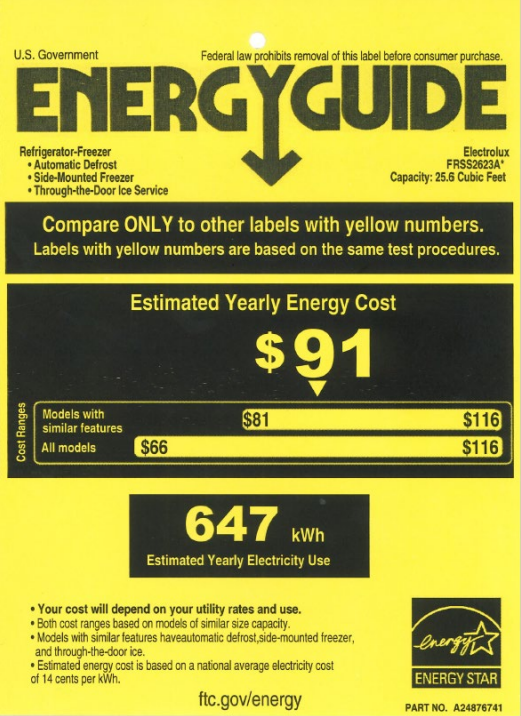
Every refrigerator sold in the United States has a yellow and black Energy Guide label listing the estimated kWh usage per year, as well as the cost associated with that usage.
That number is the single best data point for calculating the energy cost of your own refrigerator.
Multiply the estimated annual kWh usage by your electricity plan’s average price for an annual cost estimate, then divide by 12 for a monthly cost estimate.
The generic answer of “the typical refrigerator uses 300-800 watts” does not provide enough insight for you to make a decision on what type of fridge to buy your home.
First of all, that’s a very wide range, and second, refrigerator energy use depends heavily on size, configuration, and brand.
To find real patterns among those factors, we pulled Energy Star’s certified refrigerator dataset, filtered for fridges at least 5 feet tall, then broke it down by type, height, and brand.
Unsurprisingly, a few things really stood out.
Height weakly predicts how much power a refrigerator consumes, with a correlation of only 0.13.
On the other hand, volume and annual kWh usage are correlated at 0.85, making it the strongest factor we discovered.
| Height (inches) | Avg. fridge volume (ft3) | Avg. kWh/year |
|---|---|---|
| 60″-66″ | 19.0 | 377 |
| 66″-70″ | 24.3 | 497 |
| 70″-75″ | 25.1 | 539 |
| 75″+ | 21.4 | 485 |
As you can see in the table above, the tallest category uses less energy than the “70-75” range despite being taller. The answer? It has less volume.
Side-by-side and bottom-freezer models use more electricity because they’re larger, but bottom-freezer units are also the least efficient per cubic foot of any configuration, according to our dataset.
| Refrigerator door configuration | Avg. kWh/year | Avg. volume (ft3) | kWh per ft3 |
|---|---|---|---|
| Freezerless/single-door | 286 | 16.5 | 17.9 |
| Top freezer | 381 | 21.1 | 18.4 |
| Side-by-side | 636 | 30.2 | 21.1 |
| Bottom freezer | 563 | 25.2 | 23.1 |
Looking at kWh used per cubic foot of storage, clear patterns emerge among the 47 brands we analyzed.
The most efficient refrigerator brands per cubic foot:
| Brand | Avg. kWh/ft3 | Avg. volume (ft3) |
|---|---|---|
| Black+Decker | 17.2 | 25.6 |
| Elisii | 17.2 | 20.7 |
| Element | 17.6 | 19.6 |
| Upstreman | 18.5 | 19.5 |
| Avanti | 18.6 | 19.9 |
Least efficient refrigerator brands per cubic foot:
| Brand | Avg. kWh/ft3 | Avg. volume (ft3) |
|---|---|---|
| Bertazzoni | 26.1 | 20.7 |
| Fulgor Milano | 26.0 | 18.9 |
| Blomberg | 25.1 | 17.4 |
| Forno | 24.2 | 21.2 |
| Bosch | 24.1 | 24.3 |
The pattern is pretty consistent. Compact and budget-oriented brands top the efficiency list, while premium European models hang out at the bottom.
That’s not to say these brands are low-quality. They trade efficiency for cabinetry integration and design flexibility.
Among the mainstream full-size brands, Frigidaire, Midea, and Kenmore are the most efficient per cubic foot (19.3-19.8 kWh/ft3), while LG, Samsung, and KitchenAid run higher (20.5-22 kWh/ft3), mostly because their typical models are larger rather than genuinely less efficient.
Only 657 of the 2,450 models we analyzed meet Energy Star’s stricter “Most Efficient 2025” criteria. Those models average 18.6 kWh per cubic foot, compared to 21.3 kWh per cubic foot for standard Energy Star certification.
Frigidaire, GE, and Summit have the most models that meet the 2025 certification criteria.
The amount of power that a refrigerator will consume depends on the size, age, and door configuration of the appliance, as well as the geographic location of your home and how often the doors are opened.
Smaller and younger refrigerators in cold climates that are not often opened will use less power than a large, old refrigerator in a warm climate that is opened regularly.
Energy efficiency is paramount in managing your refrigerator’s energy consumption, with the Energy Star certification being a vital element to ponder when selecting an energy-efficient appliance.
Energy Star is a government-backed program that helps consumers identify energy-efficient products. Products with the Energy Star certification have met strict energy efficiency criteria and use at least 20% less energy than the minimum federal standards.

Based on our analysis of Energy-Star certified models, the average new refrigerator uses about 1.35 kWh per day (493 kWh per year ÷ 365). Older or larger models can use more.
For an average new Energy Star refrigerator, expect the electricity cost to range from $3-$7, assuming an average price per kWh of $0.12. The higher the rate, the more it will cost per month.
According to our analysis, freezerless and single-door refrigerators use the least in absolute terms, followed by top-freezer models. Side-by-side models use the most.
Yes, on a per-cubic-foot basis, bottom-freezer models are less efficient than top-freezer models. Despite being a popular configuration, bottom-freezer models use an average of 23.1 kWh per cubic foot in our dataset versus 18.4 kWh per cubic foot for top-freezer models.
Among brands with a meaningful number of Energy-Star certified models, Black+Decker, Element, and Avanti are the most efficient per cubic foot of storage. Among full-size mainstream brands, Frigidaire and Midea are the most efficient.
Lower electricity use, lower monthly bills, and a smaller carbon footprint.
Methodology: BKV Energy analyzed the current ENERGY STAR Certified Residential Refrigerators dataset (2,450 models, 145 brands) as of August 2026, examining annual kWh usage against height, adjusted volume, door configuration, and brand. We looked at models that are at least 60 inches tall and sold in United States markets.